Why add Narikala to a Georgia itinerary?
Narikala is more useful when you read it as a piece of Tbilisi's geography, not only as a viewpoint. The ridge, river crossing and bath district below explain why successive rulers kept rebuilding the same defensive position. Use Tbilisi as the practical starting point, then check the exact map position before fitting the stop into a wider Tbilisi route.

How to plan Narikala Fortress into your route
Start with the site itself, then use the closest complementary stops to avoid a day of unnecessary backtracking. These three pairings are the most useful places to consider first.
Mother of Georgia
Monument and ridge walk immediately west of the fortress.
National Botanical Garden
Garden in the valley directly behind the Narikala ridge.
Abanotubani sulfur baths
Historic bath district below the fortress.
How Narikala became the place you see today
Narikala is more useful when you read it as a piece of Tbilisi's geography, not only as a viewpoint. The ridge, river crossing and bath district below explain why successive rulers kept rebuilding the same defensive position.
A fortress site older than medieval Tbilisi
Historical references place a fortress on the Narikala ridge by late antiquity. What survives today is not one untouched building from a single period: walls and defensive elements were altered repeatedly as Persian, Arab, Georgian and later rulers controlled Tbilisi.
That layered history is why the complex feels irregular. The walls follow the steep terrain rather than forming a symmetrical castle, using the ridge itself as part of the defensive system.
The location explains the fortress
From the ridge you can see the Mtkvari River, Metekhi, Abanotubani and the approaches into Old Tbilisi. That view is more than scenic: it shows why controlling this hill meant controlling movement around the historic city.
The church precinct changed dramatically in the 19th century
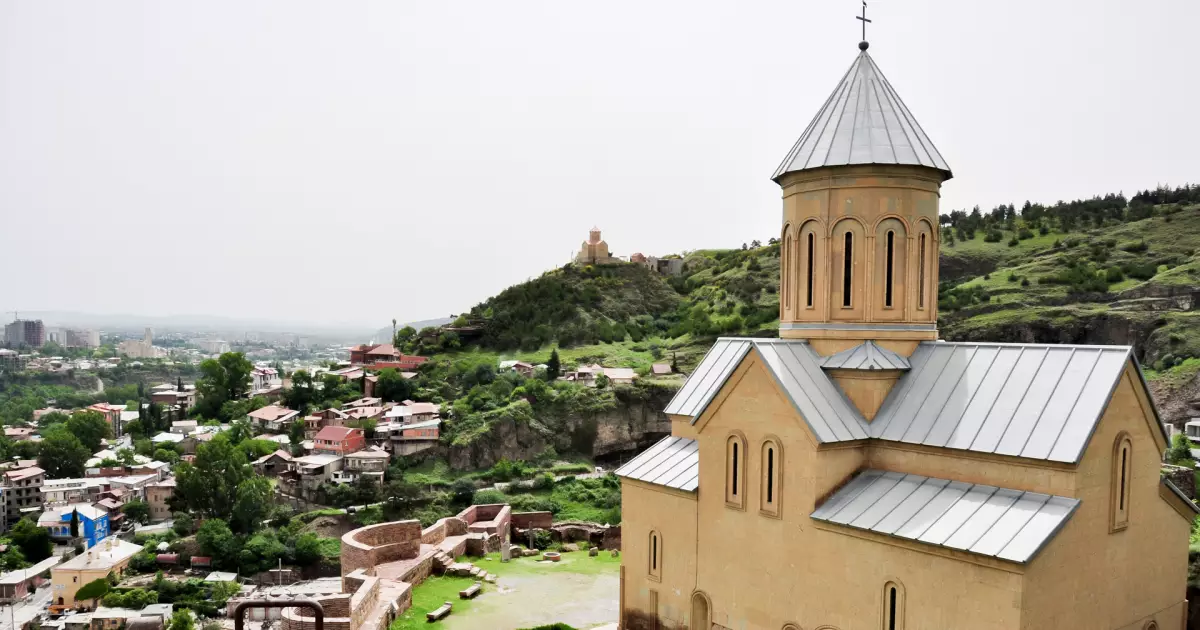
The older St Nicholas church was damaged after the fortress precinct was used for munitions and an explosion occurred in 1818. Archaeological work later identified the earlier church remains, and the present church was reconstructed in the 1990s.
A bookable way to experience Tbilisi
We only add an activity recommendation where it improves the route rather than duplicating something that is easier to visit independently. Check the live product page for the current operator, price, inclusions and cancellation terms before booking.
 Tbilisi
Tbilisi Old Town guided walking tour
A guided Old Tbilisi walk is the cleanest way to connect Narikala, Metekhi, the sulfur-bath district, the Bridge of Peace and the lanes between them without treating each sight as an isolated stop.
Its history reaches back to late antiquity
Narikala appears in historical records from the end of the fourth century, although the fortress was rebuilt and altered many times by the powers that controlled Tbilisi.
Trip.com also lists an Old Tbilisi walking option built around the historic center, local tastings and the same first-day orientation use case.
What to see at Narikala Fortress
I would not rush straight to the most photographed angle. These are the details that make the visit more useful once you are actually there.
Walk the surviving fortress walls
The complex is split across the ridge rather than arranged like a single palace. The surviving walls, towers and steep terrain make the defensive position easy to understand once you are on the hill.
See St Nicholas Church
The church in the lower court is a modern reconstruction built after archaeological work identified the remains of the earlier church that had been badly damaged after the site was used for munitions.
Use the viewpoint to read Old Tbilisi
From the ridge you can orient yourself around Abanotubani, the river, Metekhi and the dense historic center. It is one of the clearest places to understand Tbilisi's geography before continuing the sightseeing day.
Narikala Fortress: facts that add context to the visit
Its history reaches back to late antiquity
Narikala appears in historical records from the end of the fourth century, although the fortress was rebuilt and altered many times by the powers that controlled Tbilisi.
The fortress has two principal walled sections
The structure follows the steep ridge, with defensive walls enclosing upper and lower areas rather than forming one regular rectangular castle.
An explosion changed the church precinct
The older St Nicholas church was used as a munitions store in the nineteenth century and was nearly destroyed by an explosion in 1818.
Archaeology preceded the modern church
Archaeological work in the 1960s identified remains of the earlier church. The present St Nicholas Church was built in the 1990s on the lower court.
Where is Narikala Fortress?
Narikala Fortress is in Tbilisi, with the map pin at approximately 41.687778, 44.808611. Use the location map for route planning rather than estimating travel from the name of the nearest town alone.
Things to see near Narikala Fortress
Mother of Georgia
Monument and ridge walk immediately west of the fortress.
National Botanical Garden
Garden in the valley directly behind the Narikala ridge.
Abanotubani sulfur baths
Historic bath district below the fortress.
Metekhi Church
River-cliff church with views back toward Narikala.
Rike Park & Bridge of Peace
Modern riverfront stop that connects easily with the Old Town route.
Planning the visit
- Treat Narikala as part of an Old Tbilisi walking route rather than an isolated attraction.
- The fortress sits on a steep hill, so choose your approach with elevation in mind.
- Check current access conditions on the official tourism source before visiting; historic structures can have temporary restrictions.
Use Tbilisi as the accommodation starting point.
Compare real directory listings by map position and current booking source instead of choosing a room before you choose the route.
Booking.com links may earn Georgian Stays a commission at no extra cost to you.
Where the facts and image come from
Stable historical and geographic claims are checked against tourism, heritage or reference sources. Prices, opening hours and temporary access rules are deliberately not frozen into this article; use the current official source before travel.